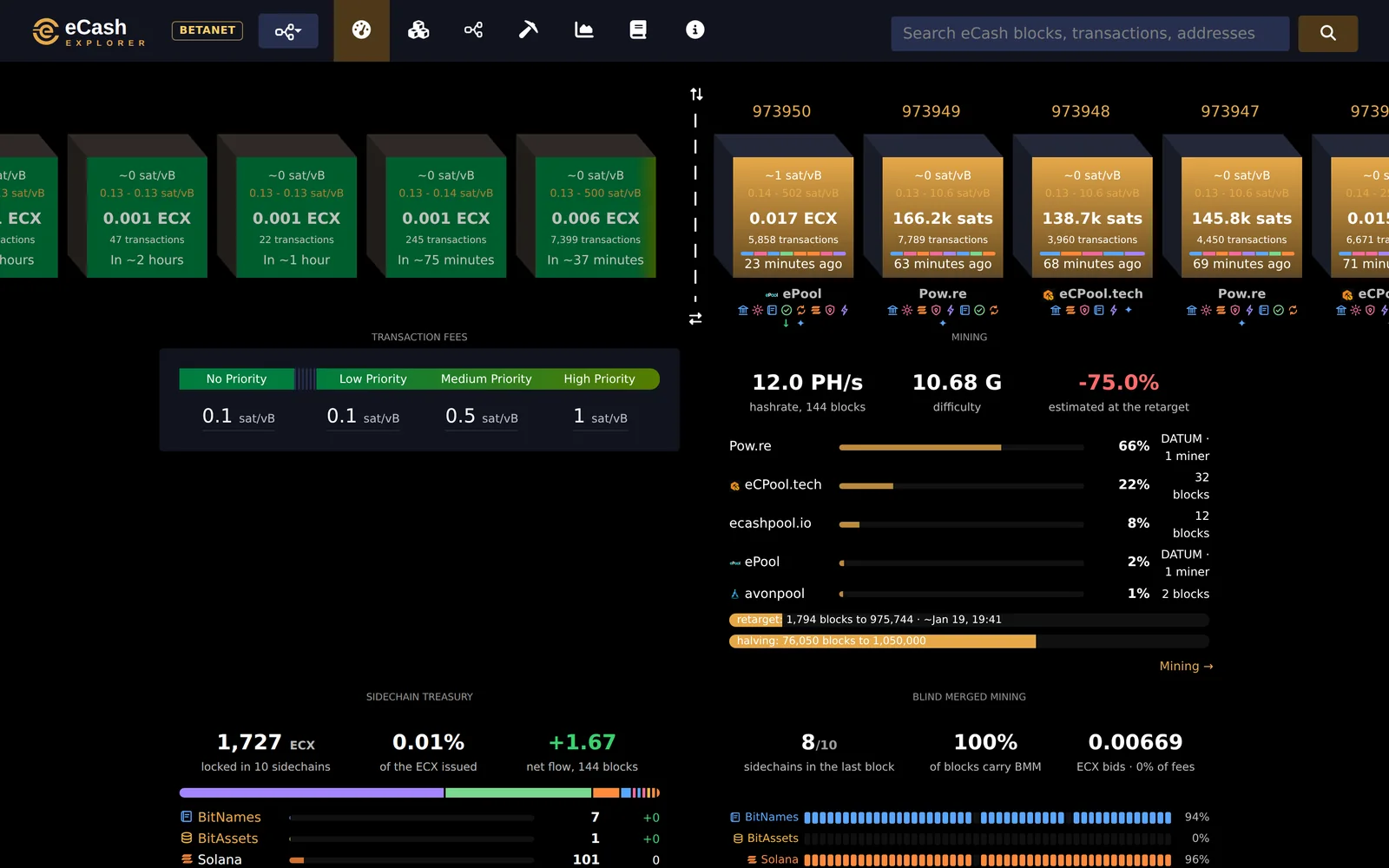
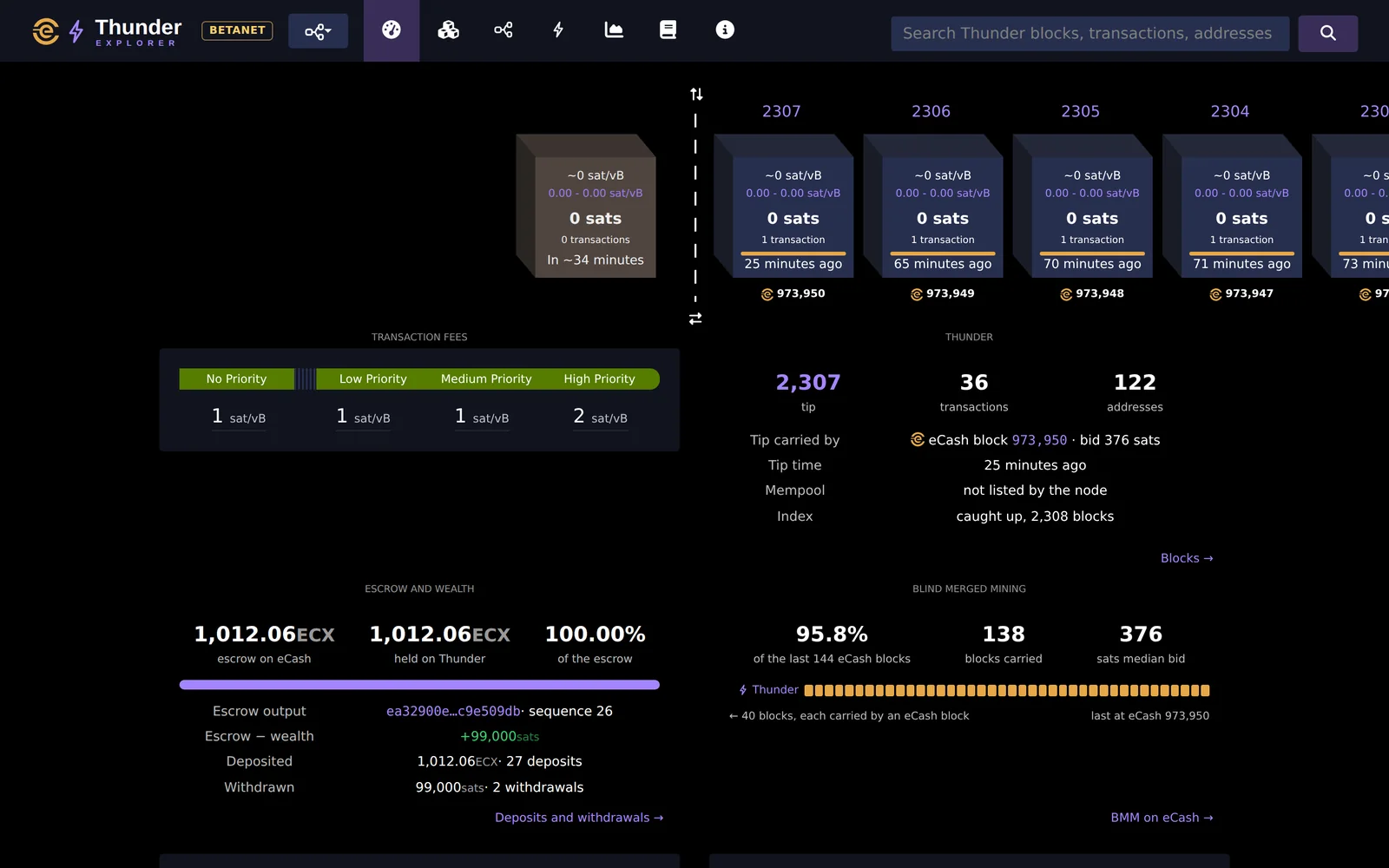
Blocks, transactions and addresses on the mainchain, plus what no other eCash explorer shows: which sidechains each block merged-mined, how much ECX sits in each sidechain's treasury, and the deposits and withdrawals moving through it. Each sidechain gets its own explorer, linked back to the eCash block that carried it.
The eCash mainchain, with the sidechain treasury and merged mining beneath it
Thunder's explorer: every block tied to the eCash block that carried it
A new space for assets, tokens and exchange.
Flush is a drivechain of eCash for tokens, assets and a DEX, with ECX as its coin. Validators who stake pegged ECX sign a block every 15 seconds, and each block is anchored to eCash by blind merged mining, so undoing an anchored block takes eCash's miners, not just stake.
How a flush.markets launch works: the price climbs along the curve as tokens sell, and at 100 ECX the token moves into a locked pool on the Flush DEX. A sketch of the shape, not live data.flush.markets, captured on the earlier slot-99 test network
A DEX without front-running
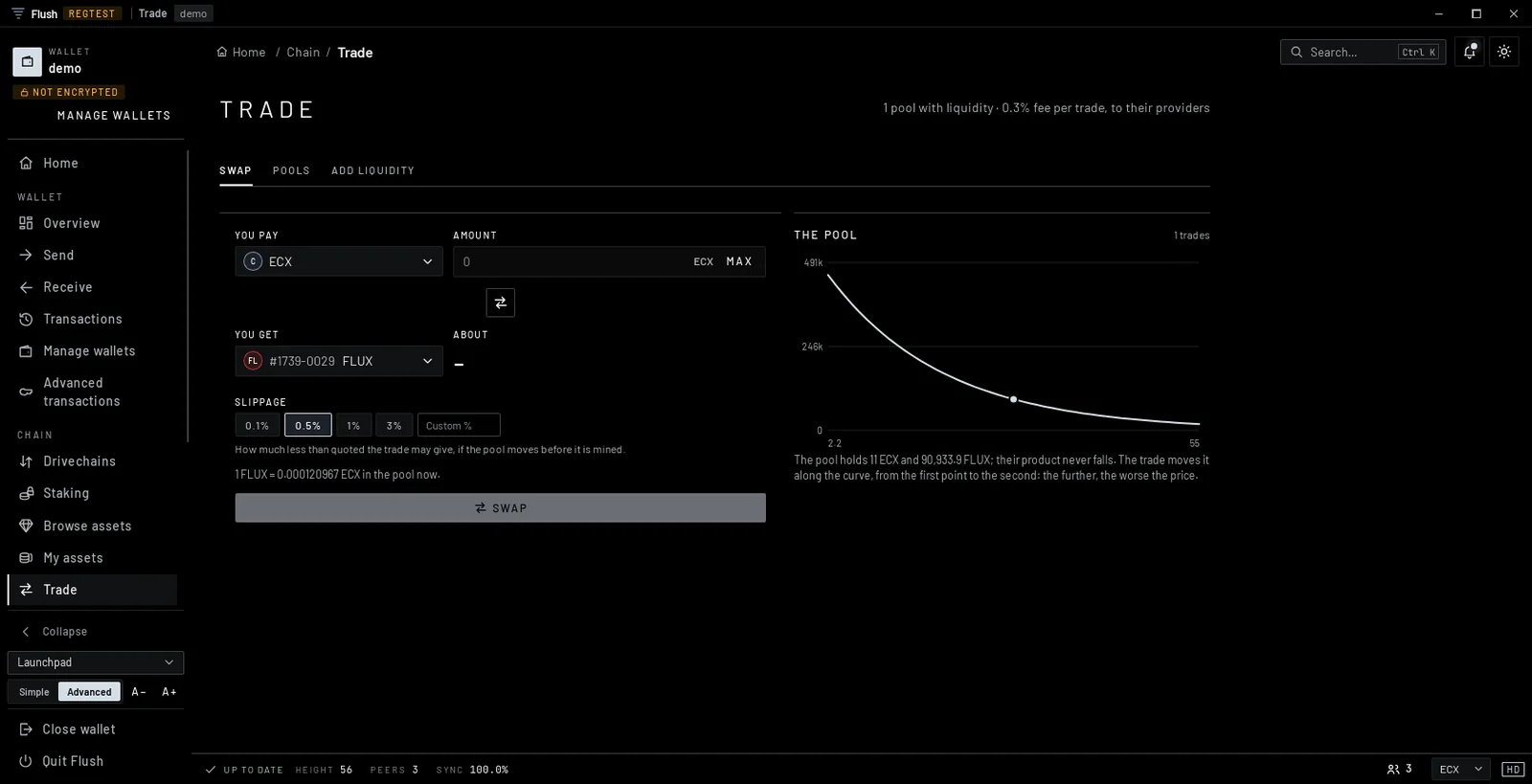
Every pool clears its trades in a batch at one price per block, so there is nothing to sandwich. Routing spans pools, with concentrated liquidity, order books and dynamic fees.
flush.markets
A launchpad for tokens issued against ECX on a bonding curve. At 100 ECX a token graduates into a locked pool on the Flush DEX.
Keys stay in the wallet
The site never holds keys. Every action goes out as a flush: link that the Flush app checks and confirms in its own dialog.
Finality you can see
Wallets show each block as soft, anchored by an eCash block, or final, so you know how settled a payment is.
Where it stands
Flush runs on eCash mainnet in its own slot, 46, active since block 978,331.
The Flush app trading against a pool, on a local test chain
The whole ecosystem. One place to begin.
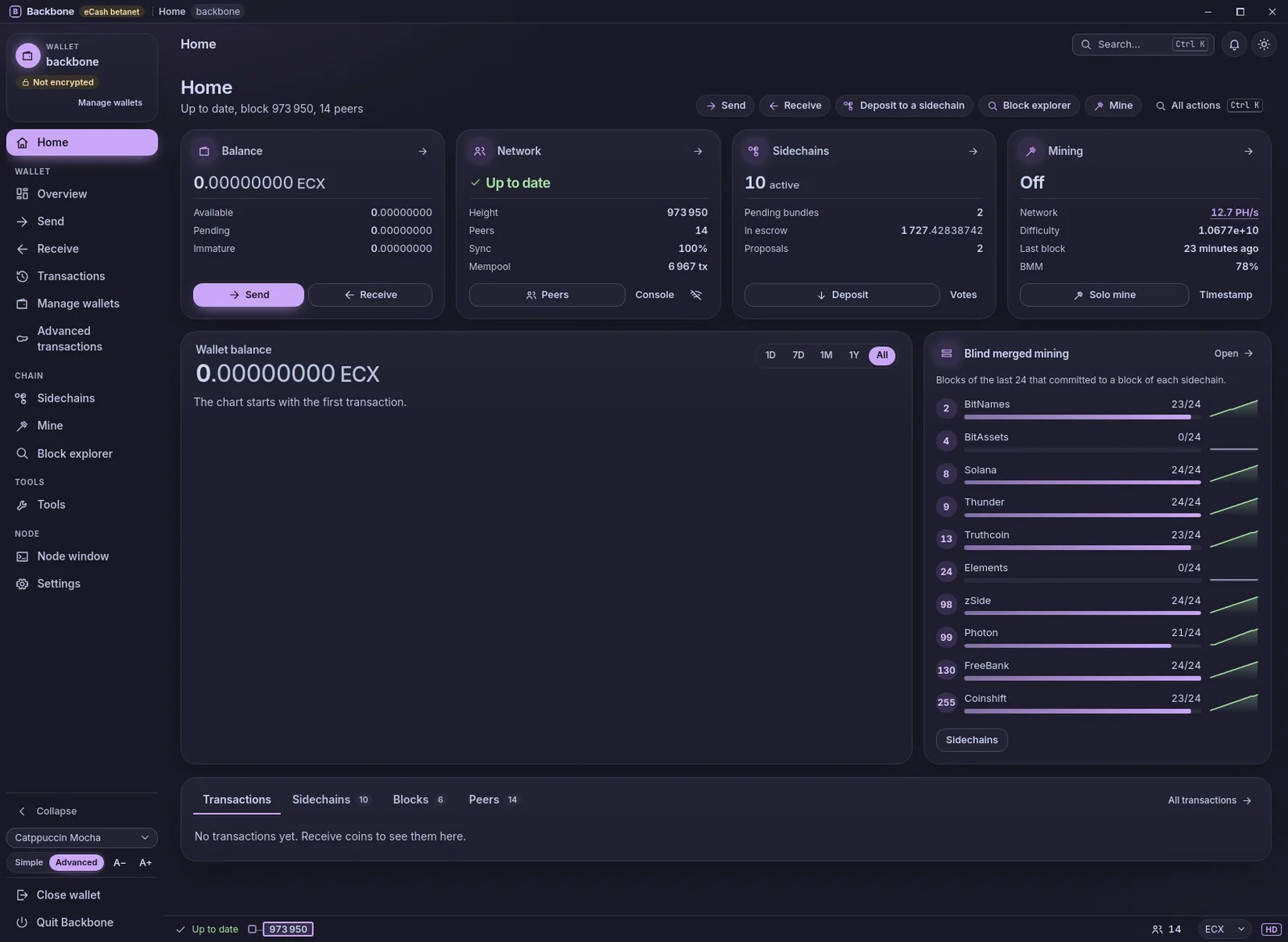
Backbone is a full eCash node with drivechains enforced inside it, a desktop wallet built around it, and our own clients for eCash's sidechains. Deposit into a sidechain, follow its merged mining, vote on withdrawals and mine, all from one app.
Backbone: the sidechains and their merged mining at a glance
The node
Built on Bitcoin Core, with BIP300 and BIP301 enforced in the node itself rather than by a separate process.
The wallet
Send, receive, deposit into any sidechain, follow withdrawals as miners vote them through, and solo-mine, in a Simple or an Advanced view.
The sidechain clients
Our own C++20 clients for six sidechains, matching the originals' consensus, peer-to-peer protocol and RPC, so they drop in where the originals ran. Flush, our own drivechain, completes the set.
One engine under all of them
FROST threshold signatures, a Utreexo port, QUIC and gRPC live in one shared core: a fix lands once and every chain picks it up.
The clientsDrop-in C++20 replacements for the reference sidechain clients, inspired by LayerTwo Labs' work, and the client for Flush, our own chain.
Slot
Sidechain
What it is for
Matched against
9
Thunder
Payments at volume, on large blocks
thunder-rust 0.18
2
BitNames
Names owned like coins
plain-bitnames 0.18
4
BitAssets
User-created assets, AMM pools and Dutch auctions
plain-bitassets 0.17
98
zSide
Private payments with Zcash's Orchard shielded pool
thunder-orchard
13
Truthcoin
Prediction markets
truthcoin-dc 0.20
255
Coinshift
Swaps across chains
coinshift-rs 0.14
46
Flush
Tokens, assets and a DEX, with 15-second blocks
Our own chain
2,262 / 2,262Coinshift block digests identical to the reference client's
49 + 34FROST signatures and Utreexo proofs verified in a full replay of Thunder's chain
629Coinshift regtest checks against the original, with zero differences
The work in progress behind the projects above.
One wallet for every chain
The Backbone app with each sidechain as an opt-in module, every chain's keys derived from one seed, and a built-in Trade page.
FastBlocks sidechain template
A template for fast sidechains: 15-second proof-of-stake blocks anchored to eCash by merged mining, with deposits, withdrawals and its own app. Flush is built on it. Source at block-fabric/backbone-fastblocks.
Sidechain template
The basic template for sidechains: merged mining, deposits, withdrawals and its own app, the starting point for a new chain. FastBlocks builds on it.
BlockFabric
Our pool engine: template building, share accounting and in-coinbase payouts, with every figure checkable against the chain.
Pools since 2013, and the racks behind them.
eCash and its drivechains are an innovation supported by LayerTwo Labs. We build on that foundation with our own infrastructure, software and ideas.
We come from the datacentre side of the business: power, cooling, networks and the discipline of keeping machines earning around the clock.
We have run mining pools since 2013 and led some of the largest hashrate venues of the altcoin booms that followed. From there we went into mining at scale, standing up dozens of farms. BlockFab is where that experience now goes into software.
2013
First pools, through the altcoin booms that followed
Then
Among the largest hashrate venues of the era
Since
Mining at scale: dozens of farms built and run
Now
A lab building eCash's explorer, wallet, sidechains and a drivechain of our own